
Points to Match Win
A new way to visualize tennis

I'm a very late convert to tennis as a watcher, let alone player. I have done the hard work of putting my individual sport prejudice aside, though, and am meeting it in good faith. I have come to terms with the scoring, one of the most bafflingly stubborn conventions I’ve witnessed in sports.1 I can tolerate the spectator culture of polite silence even if I violently disagree with it. Something I never had to be sold on, though, is the undeniable sense of inertia a match can have.2 Players get in and out of grooves, in and out of each others’ heads. The lack of clock gives matchups the same undying hope that tortures baseball fans.3
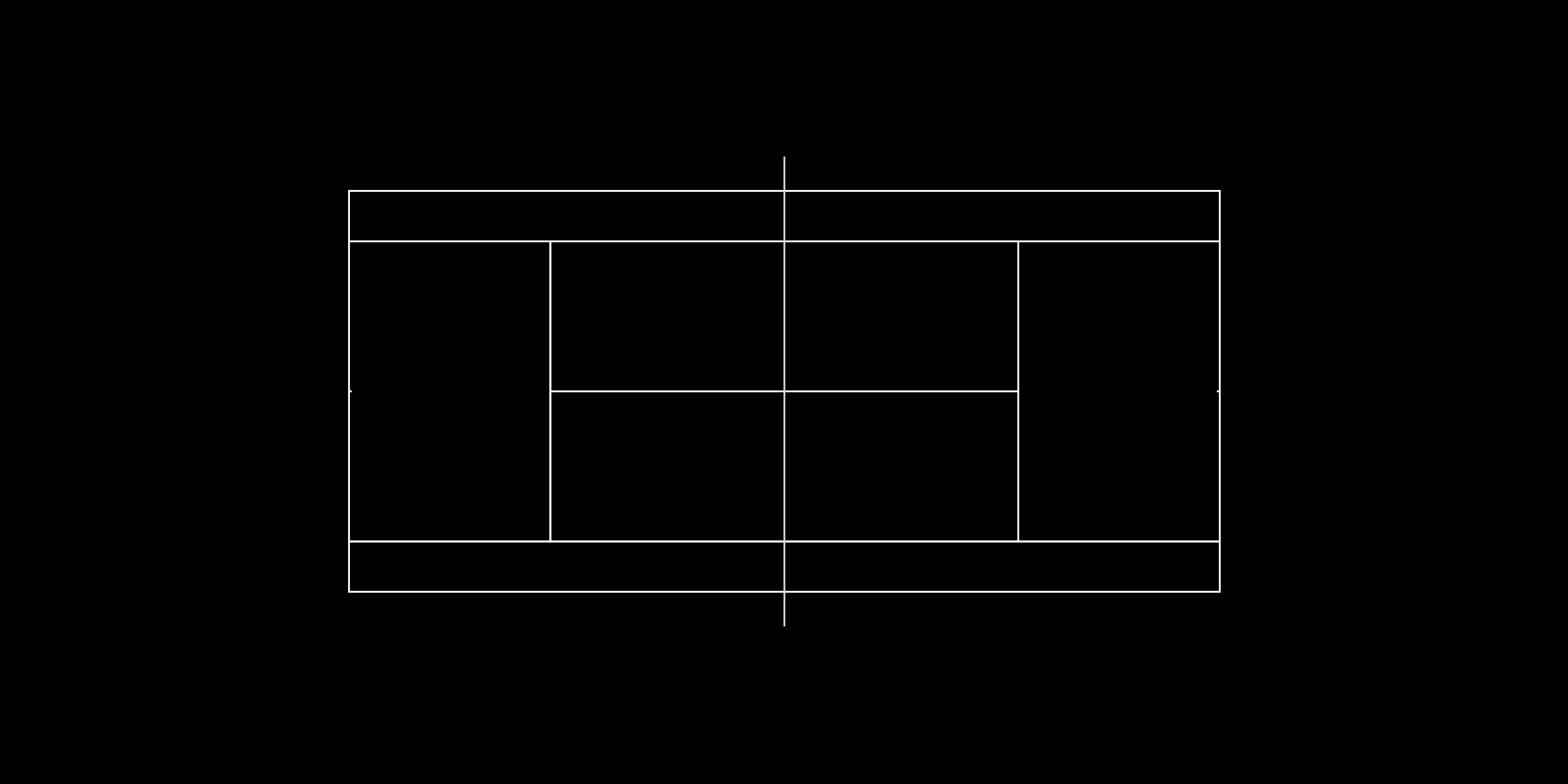
Tennis is fertile soil for chokes and comebacks, but the score sheet doesn’t always communicate the depth of a hole fallen into or climbed out of. “Match point” gives you the distance the leader has to winning, and we as viewers can digest concepts like double/triple match point to convey just how up against it the trailer is. I’m curious about this “distance to winning the match” concept through the whole lifetime of the match, and how we might be able to use it as a launching point for talking about comebacks, chokes, and a few one-sided blowouts.
Service
I’ll constrain my analysis here to the tennis scoring system used at Grand Slams, which has been uniform across tournaments since 2022. Matches are first to 2 (or 3 for men’s singles) sets straight up, sets are first to 6 (or first to 7 if both players have at least 5, with the 13th game being a special tiebreaker if needed… the mess is only beginning), and games are first to 4 points and win-by-two (except the tiebreaking 13th game which is first to 7 and win-by-two). A player who plays an entire match without dropping a point will have won 2 (or 3 for men) sets, a total of 12 (18) games, and a total of 48 (72) points.4
By the end, the winner of a tennis match is 0 points away from winning.5 Before winning, they had one or more rallies at “match point”, which is another way of saying “one point away from winning”. Extend this backwards to “match point point” (2 points away from winning), “match point point point” (3 points away), etc. Just as outs are the quantum of progress towards the end of a baseball game, this distance to winning is the forward march of a tennis match.6 From now on let’s call this measure of progress Points to Match Win, which I will shorten from now on to PotoMaW.7 It has a large family tree.
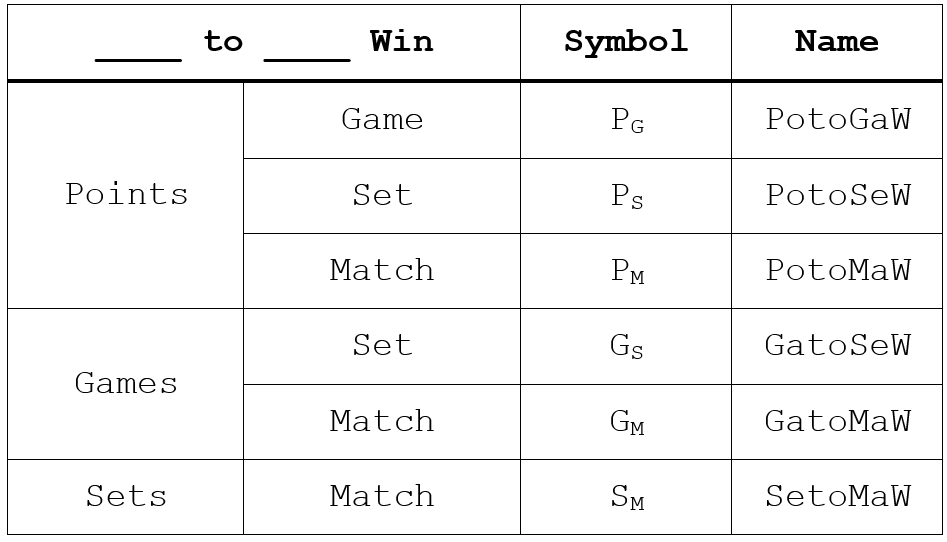
PotoMaW is built up from its constituent pieces and still contains and requires a lot of context about the state of the game. Every subscript here is in reference to the current state of the match. For example, Games to Set Win (GatoSeW) is in reference to the current set, and presumes the current game is not yet won or lost. If its value is 2, then the player of interest must win the current game and one additional game to win the set. At the very start of a match, SetoMaW is 2. At the beginning of a Set, GatoSeW is 6. At the beginning of a normal advantage game, PotoGaW is 4 (7 for tiebreakers). I won’t bore you with the journey or the tiebreaker accounting, but all together it usually looks like this:
Over the course of a competitive match, this golden8 distance to winning goes up and down for both players. By the definition/construction of “golden” here, winning a point decreases PotoMaW by 1. The increases are not as obvious.9 They are best treated as a pure before-and-after calculation rather than a flowchart or long list of contextual consequences. Any points lost during the course of a game after the first two points lost cause PotoMaW to increase by 1.10 After that it’s a bit more tangled, but still doable.
Return
Let’s look at the way our new measure changes over the course of a professional match. I’ve been told the 569-point11 thriller from Wimbledon in 2018 between Isner and Anderson was an instant classic.
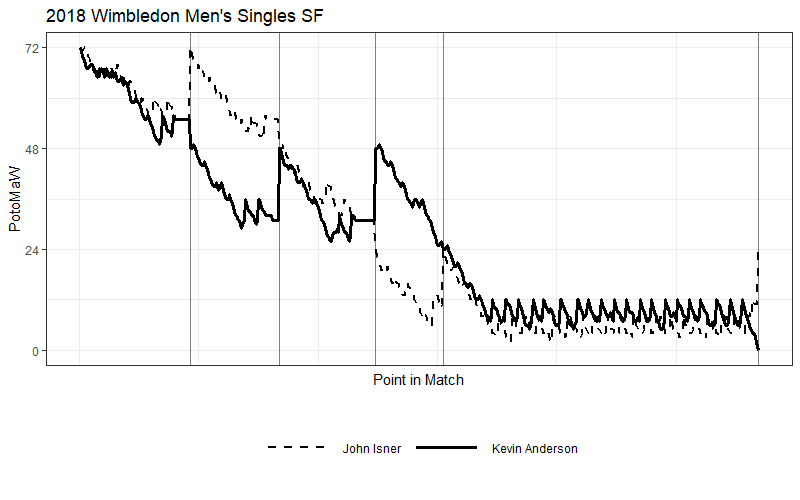
This metric as a simple timeseries is fairly information dense, which is always a good sign for exercises like this. We can see the thresholds players need to pass to “bank” progress. This race to the bottom happens in 5 chunks of 24 PotoMaW, traditionally referred to as Sets.12 We can see at a glance who leads at any point, general match and set momentum, even plateaus for both players when they are locked at deuce.
The next question is natural. Who blew the biggest PotoMaW lead in Grand Slam history?13 That curse belongs to Evgeny Donskoy, who in the first round of the 2016 US Open failed to close out on match point six times. His first match point was actually a triple match point. It came in the third set (which he was leading 5 games to 2) when he was up 40-0 on the serving Steve Johnson.14 Johnson needed the next 3 points straight, win the ensuing deuce, then win two more games straight, then win the race to 7 games from 5-5 for the set, and all that clutch would bring him to a set score of 1 to Donskoy’s 2. But the first one’s the hardest, right?
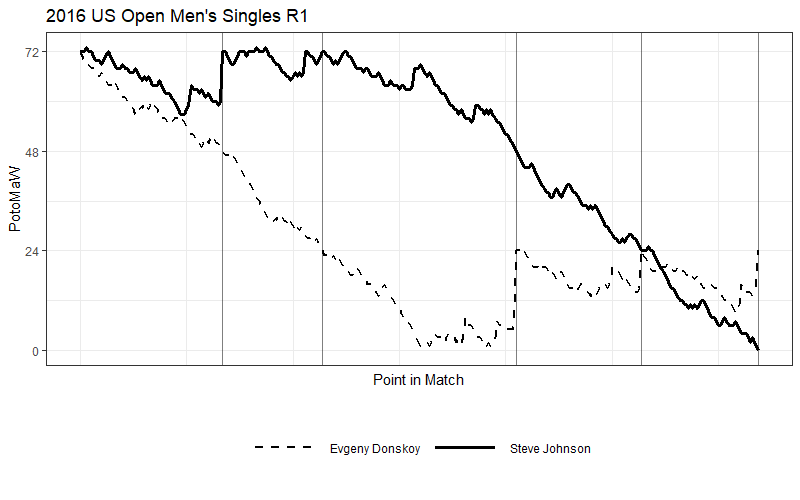
This is the largest PotoMaW lead an eventual loser coughed up in all grand slams since 2011. The gap was 68 at its worst. Let’s take some heat off Evgeny and look for the most lopsided victory in the dataset. If we sort by highest average PotoMaW, this Nadal beat-down tops the list.
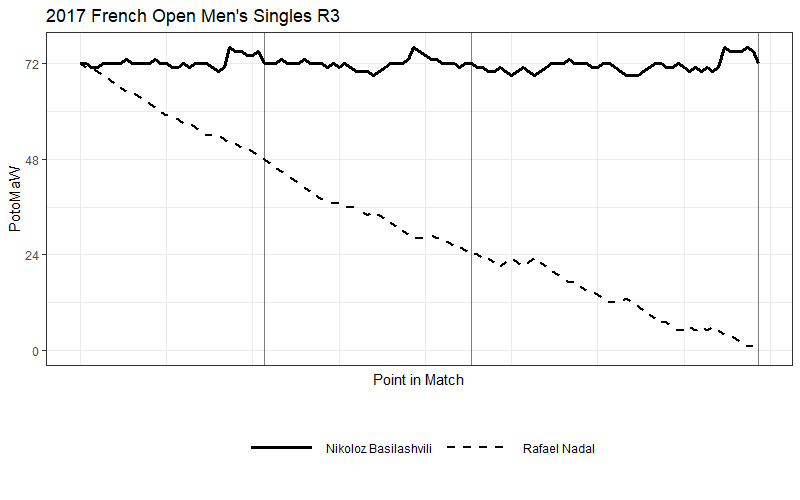
Absolutely no shade to Nikoloz Basilashvili, Georgia’s current top ranked tennis player. He just unluckily ran into Nadal on his way to winning the slam without losing a set. Basilashvili’s average PotoMaW during the match was 71.8. Of the 119 points played in this match, his PotoMaW was below 72 for only 49, and was worse in 23. He picked up one game in the second set.
Winner
Something that jumps out of those PotoMaW graphs is the set boundary. One player wins the 24-PotoMaW race to the bottom and the other has to start again. All those accumulated points and games “go nowhere” for the set loser. In fact, every point each player scores past the second point scored each game requires more effort from the opponent. This reminds me of an electoral concept called wasted votes. To borrow the parlance, game wins “waste” whatever points the game loser scored, and set wins “waste” whatever points the set loser banked in game wins.15
Tennis has other proxies for this economy of effort, like total points won, but I’m interested in quantifying these jumps in PotoMaW.16 Can we use this concept of morale damage to find an exceptional match?
The least17 amount of damage dealt by a loser to a winner is 0. This hitless speedrun was achieved once ever, by Maria Sharapova on the second part of back-to-back double-bagel matches (6-0 6-0). She achieved this one without losing more than two points in any game, so never had to win more than her initial 48 points.
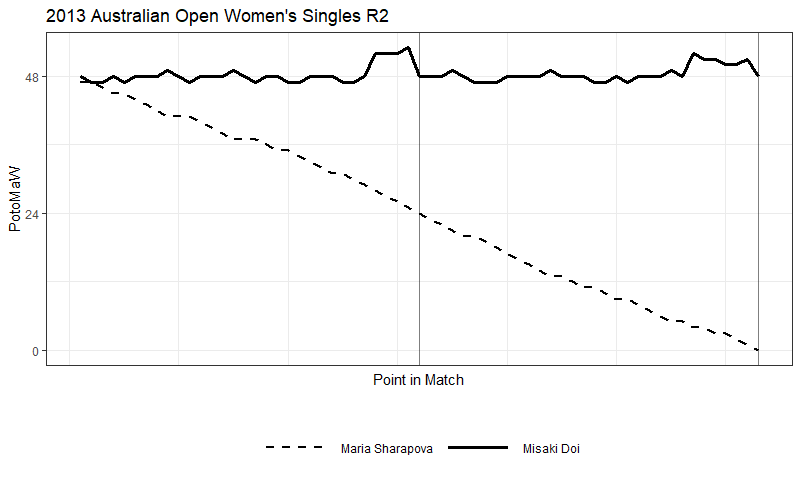
This match illustrates the genius behind tennis scoring. It is a difference magnifier, in the same way a 7 game series or 100-possession game is meant to be. The best player should win. This force multiplication is best shown with one final graph. On the x-axis is the point-dominance of the winner. (A winner who won 2x as many points as the loser would show up at the 2 here.) On the y-axis is the damage-dominance of the winner. (A winner who did 3x as much damage to PotoMaW as the loser would show up at the 3 here.)
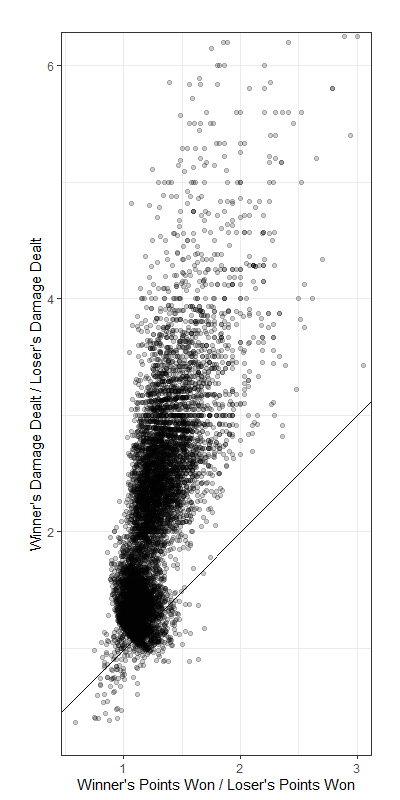
We are looking at a super-linear relationship. Point dominance is magnified in damage dominance. Winning maybe 20% more points than your opponent would typically net you around 2x the damage en route to a probable victory.18 Being better at tennis is empirically better for morale.
Other big hitters being soccer’s refusal to keep time in any sort of accurate or even semi-normal way and basketball’s live ball timeouts.
Something I also love about tennis unrelated to this post’s lede: the deep breath reset before a serve. There are a few ways that different sports grant the power of resuming action to one single player, but almost all of them manifest in that player taking a deep, focused breath. It’s also there in basketball free throws, pitcher’s windups. Three places where practitioners repeat pet routines mechanically before the action… Casting spells to trick their brains into telling their bodies to do it like they practiced. We are weird animals.
Barring some kind of technical forfeit, the chance of coming back from down 100 with 5 seconds left in a basketball game is 0%. The chance that a leader has to choke away the lead in tennis or baseball never gets all the way there.
Doesn’t really happen except in severely imbalanced or otherwise abnormal matches. They are called Golden Matches, and their little sibling is the Golden Set.
One of the dumber sentences I’ve typed and published.
Not just the rallies/points themselves, because we could be stuck at deuce forever. More on this when I get to the economy of effort.
Nailed it.
I throw this in for technicality. PotoMaW for each player is the number of points left to play if they win every point from this moment forward. It is not necessarily the minimum number of points required from now on to win the match. If I’m down 40-0, my golden distance to winning that game is 5 points. Losing the next point (so long as it doesn’t extend or decide a set) brings my golden distance to winning the next game back down to 4, the same outcome as winning the point would have had.
All this win-by-two business makes it hairy. This is also something I appreciate the sport for, as someone with a few thousand hours of pickup basketball under my belt.
This is because every point lost from the third on requires an additional point win for you to win the current game. So first-to-four win-by-two means you have two mulligans per game.
And 6 and a half hours!
If anyone at USTA wants to rebrand the clunky “Set” with the much more natural “24-PotoMaW chunk”, please contact me.
And by history, of course I mean the history of the data available to me legally for free. In this case it is back to 2011 thanks to the effortless-to-use deuce package for R.
This name is what we in statistics refer to as a mode.
Plus some mutual annihilation during deuce.
There is a philosophical question I’m avoiding here. Given a losing sequence, is it better to waste effort (forcing your opponent to also waste effort) or to minimize your own wasted effort? The answer isn’t clear, but it’s also not how we experience effort. A long deuce represents a lot of sunk cost by each player, and both would increasingly work to avoid a high effort loss in preference for a high effort win.
The most damage done by a loser came from a match that already bubbled up - the long deuce in the Isner-Anderson semifinal tiebreaker.
It was a bit difficult to puzzle out the exceptions and outliers in the plot here. A lot of matches ending early due to injury or weather. They happened to be hard to tease out in the dataset I used but represent the majority of the rebellious freckles.