
Cracking Pell Puzzles
Difficulty as an Emergent Phenomenon

I recently put a new thing out into the world called Pell Puzzles - a daily social puzzle game1 that was spawned from some of the geometric explorations that happened right here. It’s a grid deduction game, and if you or someone you know likes that kind of thing, try it out and share it! I learned a ton (combinatorics, design, web deployment) on the path to making this an actual shareable object instead of something that just lived in my head or on my machine. I get into some of that journey here, but if you’re just looking for some hints and strategy, skip to the last section.
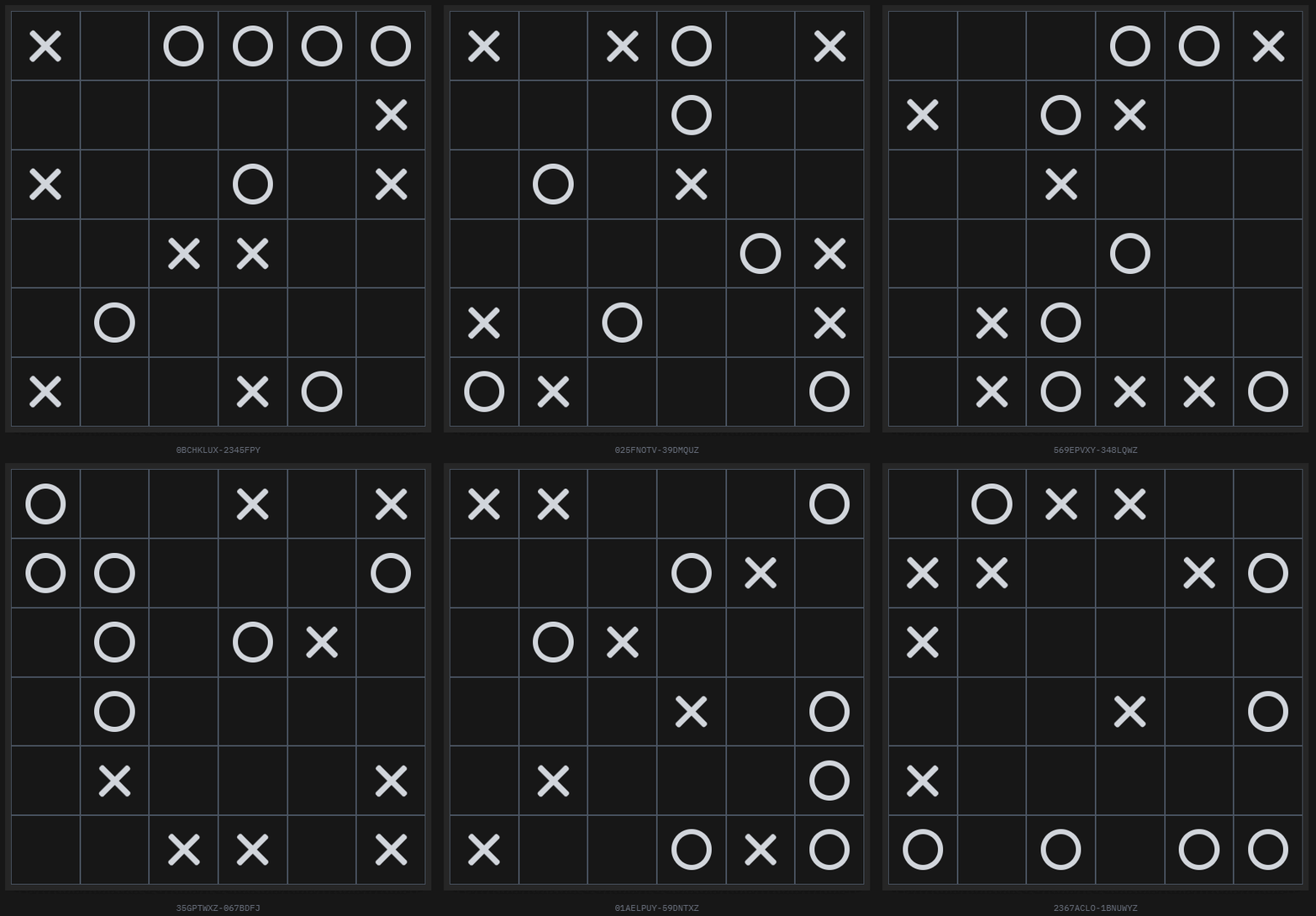
I wrote about what I named Pell Tiles in January of 2024, and what I similarly named Pell Puzzles in January 2025.2 For some background/lore, go check those posts out, and for extra extra credit, check out the experimental B-side Pellagons. I’m going to assume you have familiarity with the puzzle in this post, but you don’t need much more than what you’d gather from the How to Play on pell.achromath.com.
Counting
Ok let’s get straight into it. How many Pell Puzzles are there?
Take a square grid with 36 cells (i.e. 6 rows by 6 columns). If we want to place 8 Xs and 7 Os (leaving 21 blanks) in that space such that none of them occupy the same cell, there is a straightforward way to count up the possibilities: the Multinomial theorem.3
It quantifies “the number of ways of depositing n distinct objects into m distinct bins, with k1 objects in the first bin, k2 objects in the second bin, and so on.” For our context, “objects” are cells, and “bins” are kinds of labels (of which we have 3). So we have n=36, k1=8, k2=7, and k3=21 (our blanks). Plugging and chugging…
A tidy 35 trillion ways of placing these 15 clues in the grid.4 Most of these will surely be incoherent/incongruent with our puzzle rules, but exactly how many? I ran a solver for a while and the answer apparently is not very many! Here’s an example of a random arrangement that doesn’t work as a puzzle5:
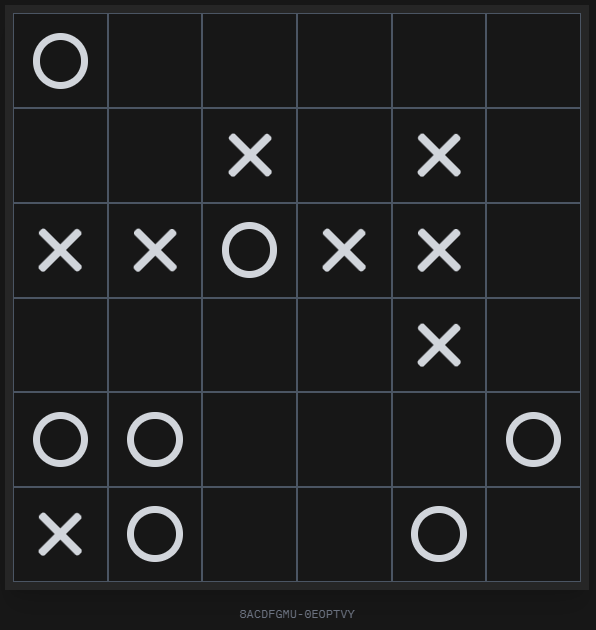
At the time of this writing, I have checked 88,255 random strings and found only 43 that describe a valid final arrangement of paths. 28 of those 43 are fully constrained, while the remainder were under-constrained. If we take this as generally representative,6 there are on the order of 17.9 billion arrangements of clues that have solutions, about 11.8 billion of which that are adequately constrained. Even if you want to be more conservative7 about this estimate, it’s a pretty long runway.
Timing
So we have long runway of these kinds of puzzles, even with pretty strict definitional constraints. If you do a few puzzles yourself, you’ll notice fairly quickly that some just “click” while others take many attempts and approaches to solve. This is something the machine agrees with us on: some Pell Puzzles are easier than others. Do we agree about which ones?8
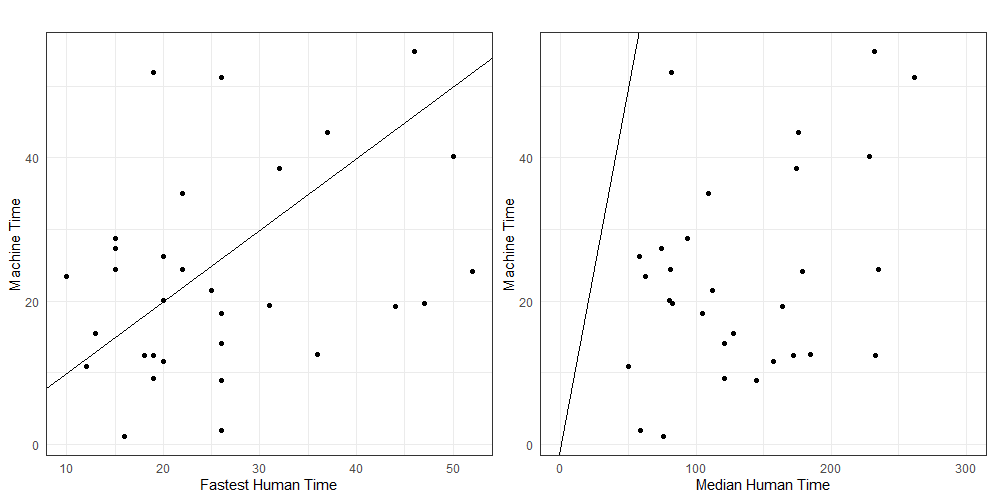
A Pell Puzzle solve typically takes someone about 2 minutes.9 This is a little skewed towards folks who are more practiced at Pell Puzzles since they are the ones who enjoy them and play more often, but this number still includes all puzzles and all players I’ve observed so far. There is some definite clustering here - certain puzzles are just easy, and others are stubbornly resistant to being solved. Here are the fastest and slowest puzzles by median solve time so far in the archive.
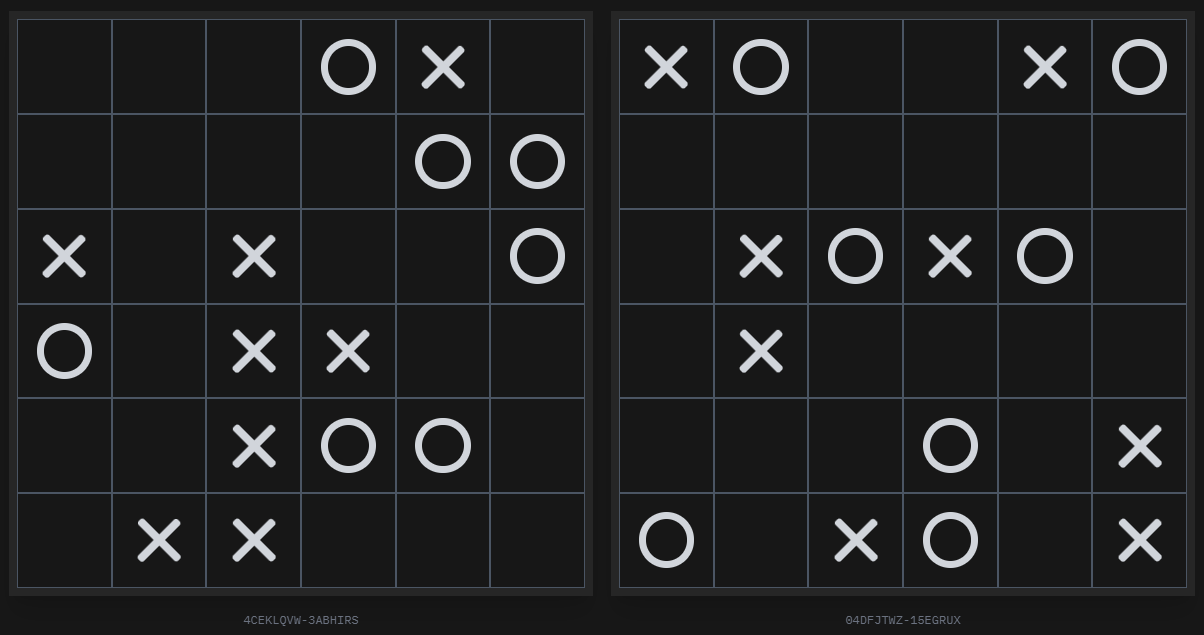
The big thing that jumps out is “gimmes”, especially in the corners. Easy puzzles have certain paths or cells that can only be satisfied one way, so the player can slot them in and move on. The remaining part of the puzzle is then materially reduced in complexity. Hard puzzles tend to have many possibilities for many if not all clues and paths, and often tempt the player into guess-and-check10 (the worst experience a puzzle designer can have for fans of logic/deduction). Machines11 do not approach puzzle-solving the same way though.
Humans can “run downhill” (i.e. follow a series of “gimmes” until the end) on a solve a bit more naturally than a computer, which enumerates the space of possibilities and then concludes as much as possible as soon as possible. The domino chain of knock-on deduction is just more steps for a machine. More to come here later, I think, as I collect more player and machine data on different puzzles and the variability of difficulty.
Plotting
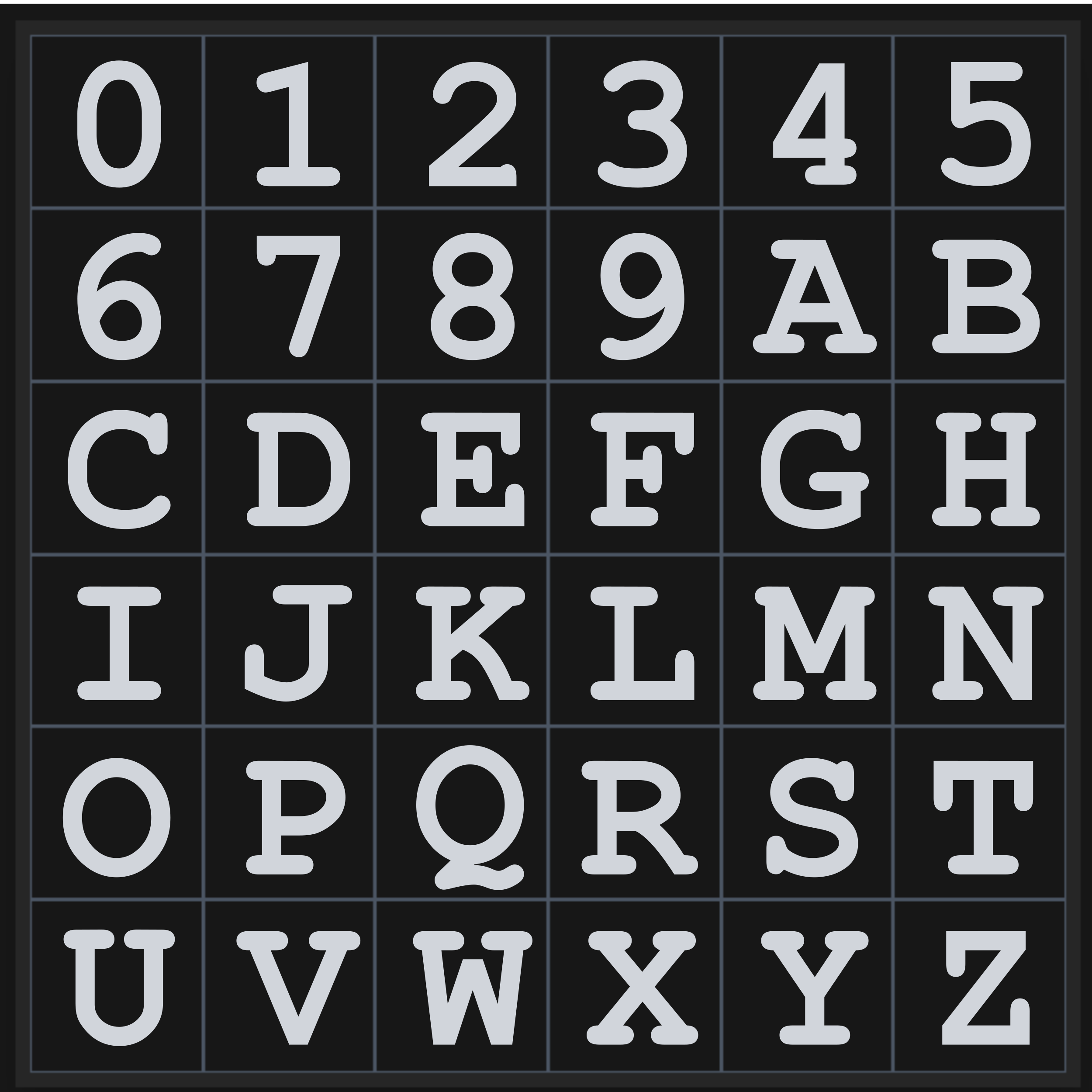
Here I’ll step through a typical solve for a Pell Puzzle. This is just one way, and by no means the best or fastest. I did a similar “tutorial” a while back on a sort of early variation on this puzzle idea. Mathematically equivalent, but the current iteration is much more playable. I’ll refer to individual cells by their character labels moving forward:
A refresher on the rules:
Fill the entire grid by creating paths between X and O endpoints.
Create exactly 8 paths, each of a different length (1 through 8). The 1-length “path” is a solitary X.
Paths cannot touch themselves (no 2x2 pools, but diagonal is ok)
Starting from the empty board:
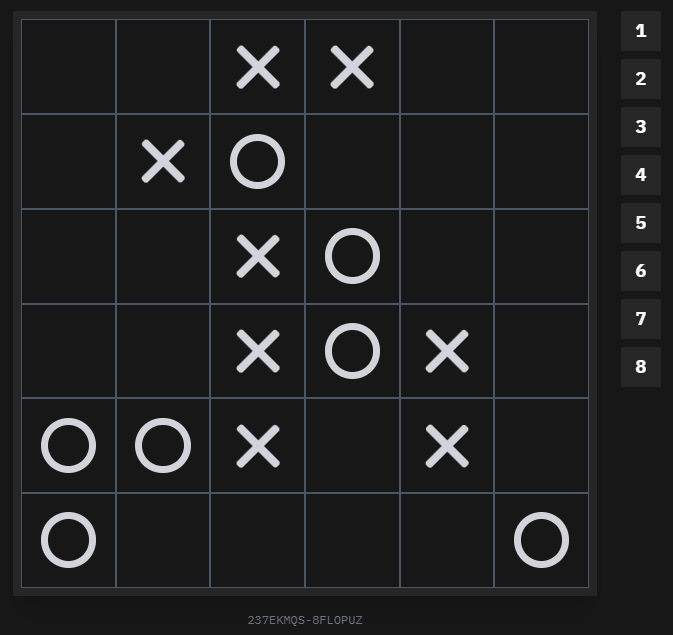
We’re going to begin at the corners. This helps us a lot here thanks to the “no 2x2 pools” rule. We can also extend some paths out from O clues since we know those cannot be the single-cell, or have two Os as endpoints.
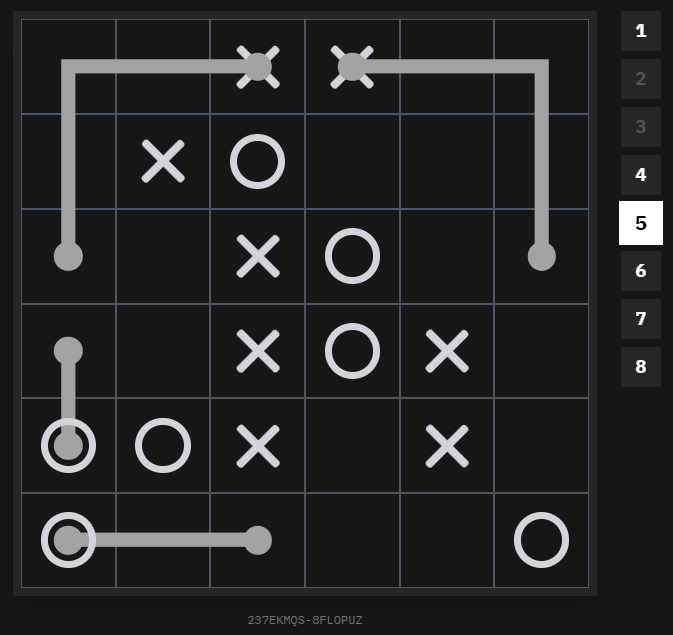
We can deduce that the path beginning at Cell 2 cannot terminate at Cell P without isolating the O at Cell O. With similar logic, we know the path from Cell 3 must go all the way to Cell Z, or else it creates dead ends. The path beginning at Cell U must terminate at Cell S, or else other dead ends or 2x2 pools are made. Our longest three paths are locked in.
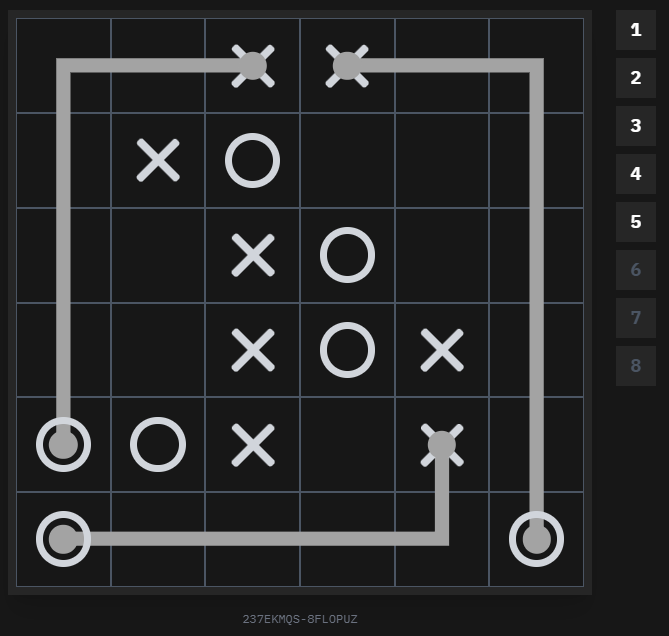
We now have new corners to leverage. Cell A and Cell R offer only one possible choice each. We now only have paths of length 1, 2, and 4 remaining.
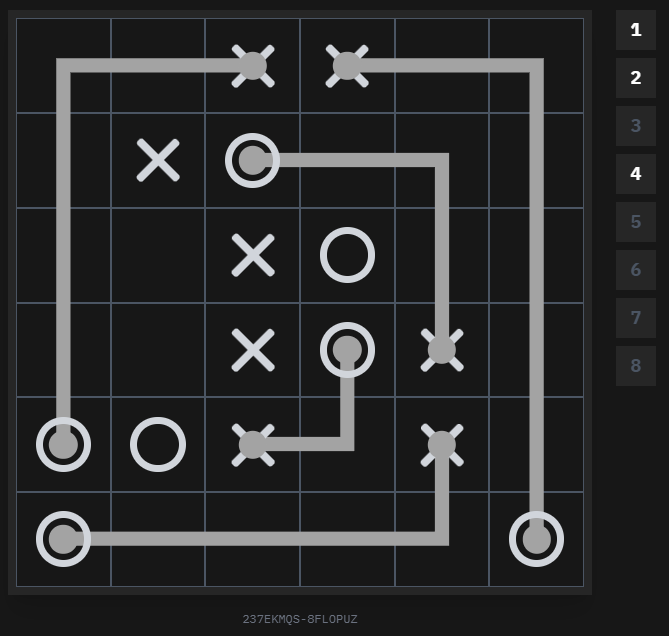
Cell F can only go west a single move, which takes care of the path of length 2. Cell P must go north, and only one of these X connections makes sense.
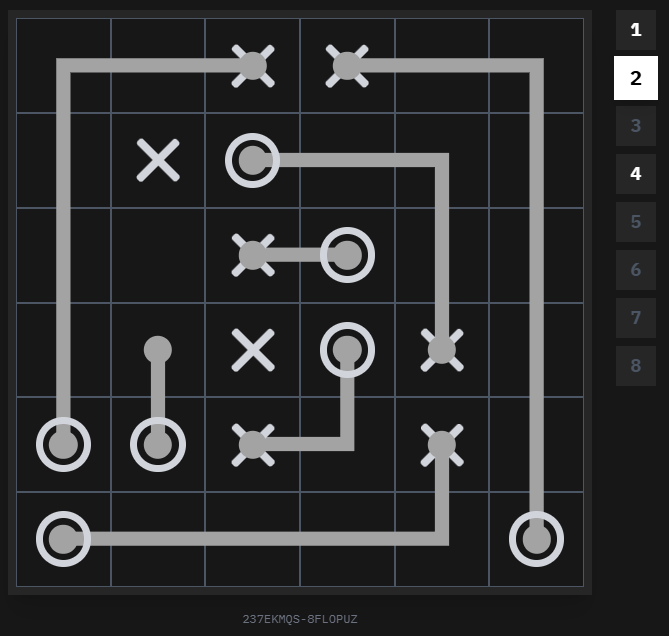
It can neither be of length 3 nor create an empty gap in Cell D. That leaves a straight line for the 4-length path.
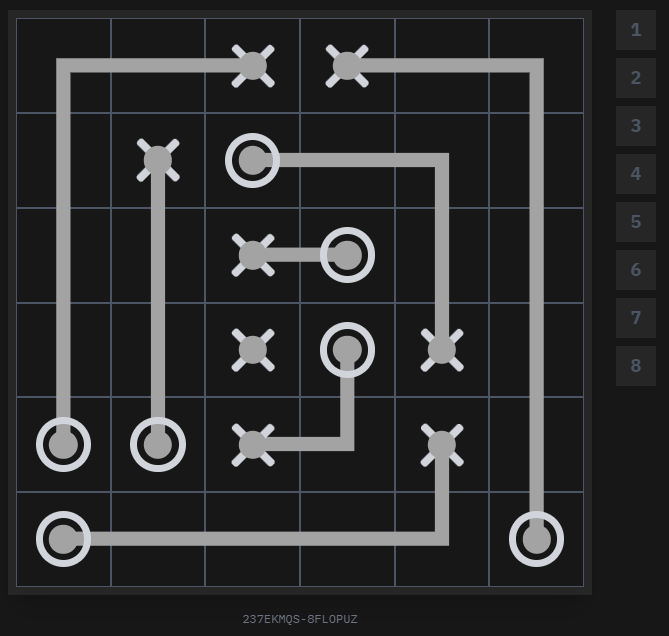
Solved!
This genre is sometimes collectively referred to as The DLEs (pronounced “dulls”) in homage to Wordle.
Ok, weird cadence that I’m unintentionally continuing here.
Not accounting for symmetry, which would bring this down by a factor of 8.
Over the course of developing some of these tools for myself, I decided to encode clues with this alpha-numeric string you see at the bottom of the image. Each cell is assigned a character (0-9 and A-Z in reading order). The first 8 characters of the string are the locations of the Xs, and the second chunk of 7 are the locations of the Os. An alternate way of getting to our 37 trillion number is to leverage this encoding by multiplying 36choose8 by 28choose7 (the number of ways of choosing 8 X characters multiplied by the number of ways of choosing 7 O characters from the remaining pool). Math is truly the highest beauty.
Taking the lower end of a 99% confidence interval brings this down to like 7.3 billion, and accounting for symmetry brings it down further by a factor of 8. That puts the very lowest floor at nearly 1 billion unique constrained clue sets.
Some caveats are probably wise here: my machine is nowhere near state-of-the-art, and my solving algorithm is far from optimized. Could be an interesting space for some machine racing, perhaps.
And dropping!
There’s a tension here that I struggle with as someone invested in designing a specific puzzle experience. I essentially made the measure of “performance” in these puzzles time-to-solve. In many cases, guess-and-check is the fastest way to cut through a complex puzzle even if there is a more elegant deductive pattern that could lead to the answer. The speed element takes something away from the solve experience of the most challenging puzzles. A cousin of Goodhart’s Law.
Or at least, the solver(s) I wrote.